
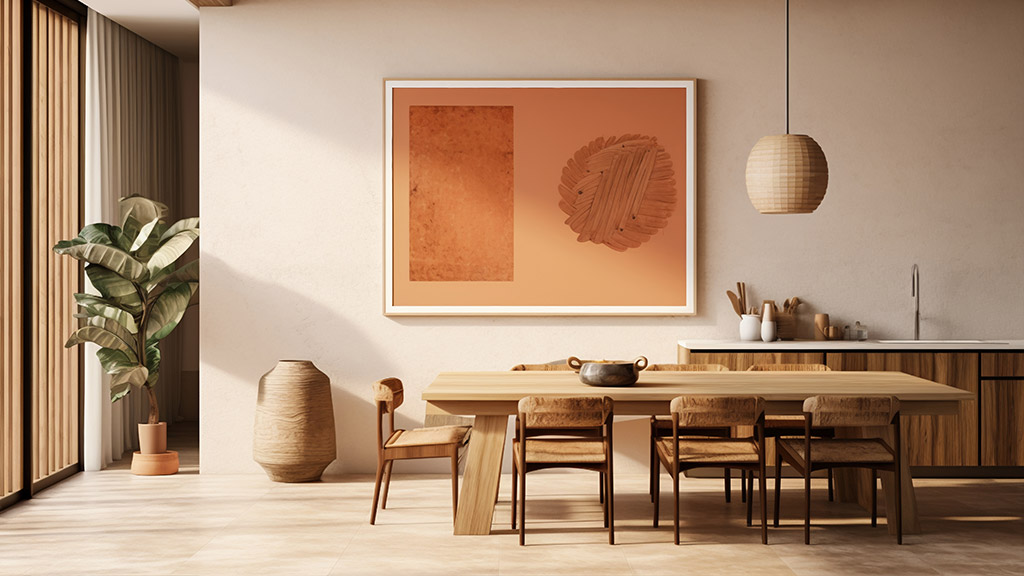
I often see enviable home spaces in newspapers and magazines, but when I look at my own home… why do other people’s homes have such dreamy interior design spaces, but I bought a lot of beautiful furniture and decorations, but they can’t achieve the same Beauty?
In fact, interior design cannot be achieved by purchasing beautiful furniture and accessories. Interior designers often pay attention to interior design principles during the planning stage. Therefore, if you want to have an environment as beautiful as the one in the magazine, you can start by understanding the following 8 space planning principles.
Interior Design Principle 1: Consistency and Coordination
If you want to live comfortably in your home, the most important thing is that the overall design must be consistent and coordinated. From the entrance, living room to bedroom, it must be seen that it is “one home”, rather than one style for the living room, another style for the kitchen, and another style for the bedroom. A style that looks cluttered and uncoordinated.
The best way to connect consistency and coordination is interior design style and color matching. For example, you can use color to connect spaces and then make partial personalized adjustments in different spaces.
Interior design principle 2: Spatial balance can bring comfort
In addition to the consistency of space, most people hope that their home space can bring “comfort”, and comfort depends on whether the proportions of the interior design are balanced.
In space planning principles, balance is often divided into three parts:
- Symmetric balance: The left and right or front and rear of the space will show mirror symmetry. For example, cabinets are placed on the left and right sides of the space, sofas are placed on the left and right sides, etc., so that people feel visually comfortable.
- Asymmetrical balance: more individual and casual style, for example, different items are placed on the left and right sides of the space, but they echo each other, creating a harmonious beauty.
- Radial balance: Using an object as the center point, and then spreading and arranging outwards, it is somewhat similar to the “divergent design” of the city.
Interior Design Principle 3: Functionality
Although people pay attention to visual beauty, they hope that their home space will look beautiful and feel like staying in a hotel.
However, a home is not a sample house for sale. It is a place where you need to live for a long time in daily life. Therefore, while pursuing aesthetics, it must also be able to meet daily needs, otherwise it will easily turn into a regrettable interior decoration!
Interior design principle 4: Fluency of movement
The so-called interior design movement line refers to whether the residents can freely and smoothly reach the living room, kitchen, bathroom, bedroom and other spaces after entering the entrance, and the logic must be smooth.
For example: there should be a walkway from the living room to the bedroom, and there should be a door or partition to separate the bedroom and bathroom.
Interior Design Principle 5: Ergonomics
Interior design principles should follow people’s usage habits and needs. Therefore, designers will take the occupant’s height, body shape, dominant hand, etc. into consideration during the planning stage so that they will not feel inconvenienced after long-term living. Therefore, ergonomics also Quite an important link.
Interior design principle 6: Create visual focus
If you want to make the indoor space look visually beautiful, you actually rely on the technique of “visual focus”.
The main purpose of the visual focus is to guide the line of sight, that is, the first thing that will be attracted after entering the space. In the living room as an example, it may be a couch that can enjoy the outdoor scenery. In the bedroom, it may be a wall with a bright color or shape that attracts attention. Visual attention.
Creating a visual focus not only attracts guests at first sight and opens up topics for discussion when inviting guests to your home, it also increases the visual experience for residents and adds a bit of fun to life.
Interior design principle 7: proportion of furniture and accessories
Some people think that a good-looking home must have good-looking furniture and decorations. However, this needs to take into account the proportions of the interior design.
For example, walking in a small space is already a challenge. If a large sofa bed is placed at this time, will it make the overall visual look more crowded and oppressive?
Therefore, professional designers will plan like this: large spaces with large square meters are equipped with large furniture and decorations, and small spaces with small square meters are equipped with exquisite small objects. This can also make the space look more coordinated.
Interior Design Principle 8: Light Planning
Finally, light is absolutely indispensable in interior design. It is an indispensable substance in people’s lives.
Generally speaking, designers will try to introduce natural lighting as much as possible, which not only makes the indoor space more vibrant, but also reduces unnecessary electricity bills.
However, if natural light cannot be introduced due to the layout, then artificial lights must be further used to create brightness and atmosphere.

